 Add to Chrome
 Add to Firefox
 Add to Edge
ECHO: Terminal Agents Learn World Models for Free
May 23, 2026
CLI agents are the closest thing language models have to an embodied setting: the model emits commands, the terminal executes them, and the returned stream -- stdout, errors, files, logs, and traces -- records the consequences. We argue that this stream is a supervision signal, but standard agent RL discards it: GRPO-style training updates action tokens with sparse outcome-level rewards while ignoring environment responses already in the rollout. Failed rollouts provide little policy-gradient signal despite containing rich evidence about how the environment responds. We introduce ECHO (Environment Cross-entropy Hybrid Objective), a hybrid objective that combines the standard policy-gradient loss on action tokens with an auxiliary loss that trains the policy to predict environment observation tokens resulting from its own actions. ECHO reuses the same forward pass as GRPO, requires no additional rollouts, and turns terminal feedback into dense supervision for all rollouts. ECHO doubles GRPO pass@1 on TerminalBench-2.0: Qwen3-8B improves from 2.70% to 5.17%, and Qwen3-14B from 5.17% to 10.79%. ECHO also produces policies that better predict terminal dynamics, even on trajectories they did not generate: across held-out rollouts, it sharply reduces environment-token cross-entropy while GRPO alone barely changes it. From base Qwen3-8B, ECHO matches expert-SFT-then-GRPO performance on held-out terminal tasks without expert demonstrations, and recovers roughly half of the expert-SFT initialization benefit on TerminalBench-2.0. In some settings, the environment prediction loss alone enables verifier-free self-improvement, allowing policies to improve on unseen OOD tasks by learning only from environment interactions. Together, these results suggest that environment observations are not merely context for future actions, but a dense, on-policy supervision signal already present in every rollout.

Open-World Evaluations for Measuring Frontier AI Capabilities
May 19, 2026Benchmark-based evaluation remains important for tracking frontier AI progress. But it can both overstate and understate deployed capability because it privileges tasks that can be precisely specified, automatically graded, easy to optimize for, and run with low budgets and short time horizons. We advocate for a complementary class of evaluations, which we term open-world evaluations: long-horizon, messy, real-world tasks assessed through small-sample qualitative analysis rather than benchmark-scale automation. In this paper we survey recent open-world evaluations, identify their strengths and limitations, and introduce CRUX (Collaborative Research for Updating AI eXpectations), a project for conducting such evaluations regularly. As a first instance, we task an AI agent with developing and publishing a simple iOS application to the Apple App Store. The agent completed the task with only a single avoidable manual intervention, suggesting that open-world evaluations can provide early warning of capabilities that may soon become widespread. We conclude with recommendations for designing and reporting open-world evals.
MEMENTO: Teaching LLMs to Manage Their Own Context
Apr 10, 2026Reasoning models think in long, unstructured streams with no mechanism for compressing or organizing their own intermediate state. We introduce MEMENTO: a method that teaches models to segment reasoning into blocks, compress each block into a memento, i.e., a dense state summary, and reason forward by attending only to mementos, reducing context, KV cache, and compute. To train MEMENTO models, we release OpenMementos, a public dataset of 228K reasoning traces derived from OpenThoughts-v3, segmented and annotated with intermediate summaries. We show that a two-stage SFT recipe on OpenMementos is effective across different model families (Qwen3, Phi-4, Olmo 3) and scales (8B--32B parameters). Trained models maintain strong accuracy on math, science, and coding benchmarks while achieving ${\sim}2.5\times$ peak KV cache reduction. We extend vLLM to support our inference method, achieving ${\sim}1.75\times$ throughput improvement while also enabling us to perform RL and further improve accuracy. Finally, we identify a dual information stream: information from each reasoning block is carried both by the memento text and by the corresponding KV states, which retain implicit information from the original block. Removing this channel drops accuracy by 15\,pp on AIME24.
Endless Terminals: Scaling RL Environments for Terminal Agents
Jan 27, 2026Environments are the bottleneck for self-improving agents. Current terminal benchmarks were built for evaluation, not training; reinforcement learning requires a scalable pipeline, not just a dataset. We introduce Endless Terminals, a fully autonomous pipeline that procedurally generates terminal-use tasks without human annotation. The pipeline has four stages: generating diverse task descriptions, building and validating containerized environments, producing completion tests, and filtering for solvability. From this pipeline we obtain 3255 tasks spanning file operations, log management, data processing, scripting, and database operations. We train agents using vanilla PPO with binary episode level rewards and a minimal interaction loop: no retrieval, multi-agent coordination, or specialized tools. Despite this simplicity, models trained on Endless Terminals show substantial gains: on our held-out dev set, Llama-3.2-3B improves from 4.0% to 18.2%, Qwen2.5-7B from 10.7% to 53.3%, and Qwen3-8B-openthinker-sft from 42.6% to 59.0%. These improvements transfer to human-curated benchmarks: models trained on Endless Terminals show substantial gains on held out human curated benchmarks: on TerminalBench 2.0, Llama-3.2-3B improves from 0.0% to 2.2%, Qwen2.5-7B from 2.2% to 3.4%, and Qwen3-8B-openthinker-sft from 1.1% to 6.7%, in each case outperforming alternative approaches including models with more complex agentic scaffolds. These results demonstrate that simple RL succeeds when environments scale.
Wait, Wait, Wait... Why Do Reasoning Models Loop?
Dec 15, 2025Reasoning models (e.g., DeepSeek-R1) generate long chains of thought to solve harder problems, but they often loop, repeating the same text at low temperatures or with greedy decoding. We study why this happens and what role temperature plays. With open reasoning models, we find that looping is common at low temperature. Larger models tend to loop less, and distilled students loop significantly even when their teachers rarely do. This points to mismatches between the training distribution and the learned model, which we refer to as errors in learning, as a key cause. To understand how such errors cause loops, we introduce a synthetic graph reasoning task and demonstrate two mechanisms. First, risk aversion caused by hardness of learning: when the correct progress-making action is hard to learn but an easy cyclic action is available, the model puts relatively more probability on the cyclic action and gets stuck. Second, even when there is no hardness, Transformers show an inductive bias toward temporally correlated errors, so the same few actions keep being chosen and loops appear. Higher temperature reduces looping by promoting exploration, but it does not fix the errors in learning, so generations remain much longer than necessary at high temperature; in this sense, temperature is a stopgap rather than a holistic solution. We end with a discussion of training-time interventions aimed at directly reducing errors in learning.
Extrapolation by Association: Length Generalization Transfer in Transformers
Jun 10, 2025Transformer language models have demonstrated impressive generalization capabilities in natural language domains, yet we lack a fine-grained understanding of how such generalization arises. In this paper, we investigate length generalization--the ability to extrapolate from shorter to longer inputs--through the lens of \textit{task association}. We find that length generalization can be \textit{transferred} across related tasks. That is, training a model with a longer and related auxiliary task can lead it to generalize to unseen and longer inputs from some other target task. We demonstrate this length generalization transfer across diverse algorithmic tasks, including arithmetic operations, string transformations, and maze navigation. Our results show that transformer models can inherit generalization capabilities from similar tasks when trained jointly. Moreover, we observe similar transfer effects in pretrained language models, suggesting that pretraining equips models with reusable computational scaffolding that facilitates extrapolation in downstream settings. Finally, we provide initial mechanistic evidence that length generalization transfer correlates with the re-use of the same attention heads between the tasks. Together, our findings deepen our understanding of how transformers generalize to out-of-distribution inputs and highlight the compositional reuse of inductive structure across tasks.
Phi-4-reasoning Technical Report
Apr 30, 2025We introduce Phi-4-reasoning, a 14-billion parameter reasoning model that achieves strong performance on complex reasoning tasks. Trained via supervised fine-tuning of Phi-4 on carefully curated set of "teachable" prompts-selected for the right level of complexity and diversity-and reasoning demonstrations generated using o3-mini, Phi-4-reasoning generates detailed reasoning chains that effectively leverage inference-time compute. We further develop Phi-4-reasoning-plus, a variant enhanced through a short phase of outcome-based reinforcement learning that offers higher performance by generating longer reasoning traces. Across a wide range of reasoning tasks, both models outperform significantly larger open-weight models such as DeepSeek-R1-Distill-Llama-70B model and approach the performance levels of full DeepSeek-R1 model. Our comprehensive evaluations span benchmarks in math and scientific reasoning, coding, algorithmic problem solving, planning, and spatial understanding. Interestingly, we observe a non-trivial transfer of improvements to general-purpose benchmarks as well. In this report, we provide insights into our training data, our training methodologies, and our evaluations. We show that the benefit of careful data curation for supervised fine-tuning (SFT) extends to reasoning language models, and can be further amplified by reinforcement learning (RL). Finally, our evaluation points to opportunities for improving how we assess the performance and robustness of reasoning models.
VersaPRM: Multi-Domain Process Reward Model via Synthetic Reasoning Data
Feb 10, 2025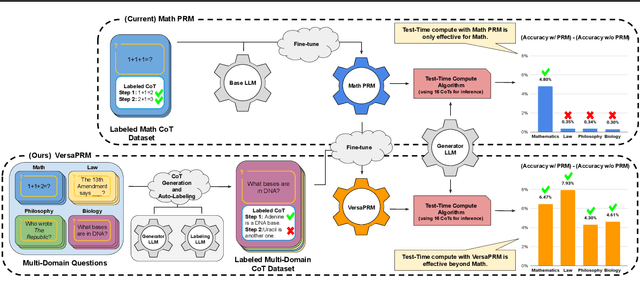
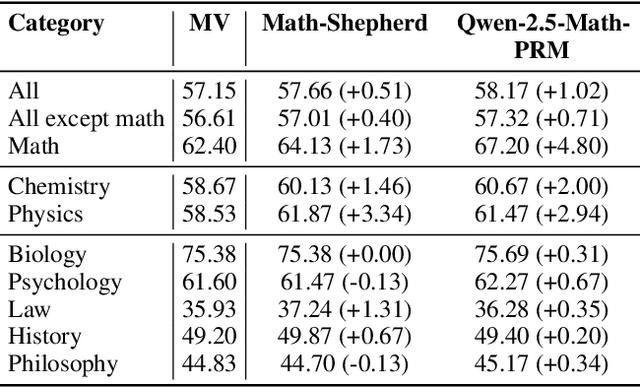
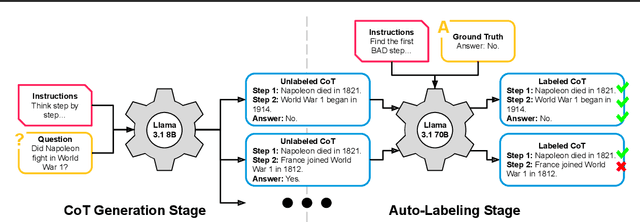

Process Reward Models (PRMs) have proven effective at enhancing mathematical reasoning for Large Language Models (LLMs) by leveraging increased inference-time computation. However, they are predominantly trained on mathematical data and their generalizability to non-mathematical domains has not been rigorously studied. In response, this work first shows that current PRMs have poor performance in other domains. To address this limitation, we introduce VersaPRM, a multi-domain PRM trained on synthetic reasoning data generated using our novel data generation and annotation method. VersaPRM achieves consistent performance gains across diverse domains. For instance, in the MMLU-Pro category of Law, VersaPRM via weighted majority voting, achieves a 7.9% performance gain over the majority voting baseline -- surpassing Qwen2.5-Math-PRM's gain of 1.3%. We further contribute to the community by open-sourcing all data, code and models for VersaPRM.
Self-Improving Transformers Overcome Easy-to-Hard and Length Generalization Challenges
Feb 03, 2025Large language models often struggle with length generalization and solving complex problem instances beyond their training distribution. We present a self-improvement approach where models iteratively generate and learn from their own solutions, progressively tackling harder problems while maintaining a standard transformer architecture. Across diverse tasks including arithmetic, string manipulation, and maze solving, self-improving enables models to solve problems far beyond their initial training distribution-for instance, generalizing from 10-digit to 100-digit addition without apparent saturation. We observe that in some cases filtering for correct self-generated examples leads to exponential improvements in out-of-distribution performance across training rounds. Additionally, starting from pretrained models significantly accelerates this self-improvement process for several tasks. Our results demonstrate how controlled weak-to-strong curricula can systematically teach a model logical extrapolation without any changes to the positional embeddings, or the model architecture.
Task Vectors in In-Context Learning: Emergence, Formation, and Benefit
Jan 16, 2025In-context learning is a remarkable capability of transformers, referring to their ability to adapt to specific tasks based on a short history or context. Previous research has found that task-specific information is locally encoded within models, though their emergence and functionality remain unclear due to opaque pre-training processes. In this work, we investigate the formation of task vectors in a controlled setting, using models trained from scratch on synthetic datasets. Our findings confirm that task vectors naturally emerge under certain conditions, but the tasks may be relatively weakly and/or non-locally encoded within the model. To promote strong task vectors encoded at a prescribed location within the model, we propose an auxiliary training mechanism based on a task vector prompting loss (TVP-loss). This method eliminates the need to search for task-correlated encodings within the trained model and demonstrably improves robustness and generalization.